LbCas12a nuclease is a crRNA-mediated nuclease that recognizes and cleaves double-stranded DNA (dsDNA) in the presence of a PAM (Protospacer Adjacent Motif) sequence (TTN). The results can be observed by fluorometer and test strips.
* For research use only. Not intended for use in humans or animals, including clinical, therapeutic, or diagnostic purposes.
Product Description
LbCas12a nuclease (also known as Cpf) is derived from Lachnospiraceae bacterium ND2006 strain. LbCas12a belongs to class 2 type V CRISPR effector proteins, and is a crRNA-mediated nuclease that recognizes and cleaves double-stranded DNA (dsDNA) in the presence of a PAM (Protospacer Adjacent Motif) sequence (TTTV). For single-stranded DNA (ssDNA) cleavage, the PAM sequence is not required. Upon binding to complementary ssDNA or dsDNA, the trans-cleavage activity of LbCas12a on non-specific ssDNA is activated. By designing single-stranded Reporter DNA labeled with fluorescent moieties or other small molecules at both ends, the detection and signal amplification of the DNA template by Cas12a can be realized. The results can be observed by fluorometer and test strips.
Product Components
| Component |
EDE0005-100 |
EDE0005-1000 |
EDE0005-2000 |
| LbCas12a Nuclease |
1 μM*100 μL(100 pmol) |
1 μM*500 μL*2tube(1000 pmol) |
1 μM*500 μL*4tube(2000 pmol) |
| LbCas12a Cleavage Buffer(10×) 500 μL*1tube |
1mL*4tube |
1mL*7tube |
Test Reaction System
| Component |
Final Concentration |
Volume ( μL) |
| 10× Cleavage Buffer |
1× |
3 |
| 1 μM LbCas12a Nuclease |
33 nM |
1 |
| 500 nM crRNA |
33 nM |
2 |
| 2 μM ssDNA Reporter |
400 nM |
6 |
| 100 nM DNA target |
3.3 nM |
1 |
| DEPC H2O |
|
|
| Total |
30 μL |
30 μL |
Reaction Conditions
Use a real-time fluorescence quantitative PCR machine or an isothermal amplification instrument to detect the fluorescence signal. The reaction should occur at 37°C, and the fluorescence signal should be collected every 30 seconds. Alternatively, the fluorescence signal can be directly observed under a UV light.
Cross-Analysis of Competitive Performance
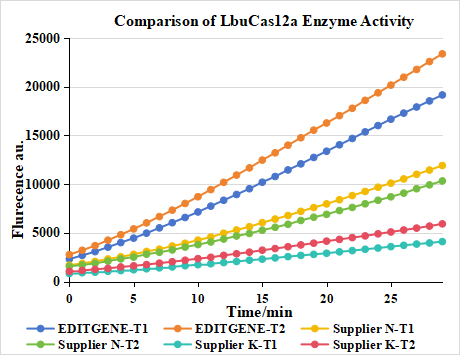
Fig 1. Results of Cas12a collateral cleavage at different company product. The abscissa is the reaction time, and the ordinate is the detection result of Bio-rad CFX96 fluorescence PCR instrument. As can be seen from the figure, under the same conditions, the cutting efficiency of this product is significantly higher than that of similar products.
Storage Conditions and Shelf Life
The product is stable for 1 year when stored at -20°C. For long-term storage, it is recommended to store at -80°C. It is advised to aliquot the product based on the frequency of use to avoid repeated freeze-thaw cycles.
* Research Use Disclaimer: Content is generated from publicly available research data, bioinformatic resources, and computational analyses for research reference only.
Customer Publications
Controlled CRISPR/Cas12a activation via DNAzyme-mediated splitting of chimeric substrate for lead detection
Direct microRNA detection via topologically engineered CRISPR/Cas12a cascade amplification assay
IF=4.6
Spectrochimica Acta Part A: Molecular and Biomolecular Spectroscopy
Asy-RPA/PCR combined with One-crRNA-CRISPR/Cas12a for simultaneous detection of multiple Clarithromycin resistance mutations in Helicobacter pylori
IF=4.6
Nanomedicine: Nanotechnology, Biology and Medicine
Establishment of One-Pot ERA-CRISPR/Cas12a-Based Rapid Visual Assays and a TaqMan Quantitative PCR Assay for Lactococcus garvieae
A ratiometric and trans-cleavage-triggered feedback CRISPR/Cas12a cascade for amplification-free microRNA detection using a multifunctional switch
Visual CRISPR/Cas12a-mediated Rapid Detection of Gyrovirus galga1
IF=5.4
Pakistan Veterinary Journal
DNAzyme-driven SDA reaction regulates CRISPR/Cas12a for highly sensitive and selective analysis of underexpressed miRNA
IF=6
Analytica Chimica Acta
Field-parallel six-sample microfluidic detection of plant viruses via raffinose-assisted one-pot LAMP-CRISPR/Cas12b
IF=13
Journal of Advanced Research
cliCRISPR: crRNA-limited CRISPR/Cas12a system for multiplexed detection
IF=10.5
Biosensors and Bioelectronics
A multifunctional switch for label-free CRISPR/Cas12a sensor with self-driven amplification
IF=4.4
Synthetic and Systems Biotechnology
A dual fluorescence channel RAA-based CRISPR-Cas12a/Cas13a system for highly sensitive detection of Gyrovirus galga1 and Gyrovirus homsa1
CRISPR/Cas12a-mediated DNAzyme/split-aptamer cascade for label-free detection of site-specific DNA methylation
IF=10.5
Biosensors and Bioelectronics
A small library crRNA-enhanced CRISPR-Cas12a system for ultrasensitive point-of-care test of hantavirus M gene
IF=4.9
Sensing and Bio-Sensing Research
Point-of-care testing diagnosis of African swine fever virus by targeting multiple genes with enzymatic recombinase amplification and CRISPR/Cas12a System
IF=4.8
Frontiers in Cellular and Infection Microbiology
Rapid and multiple visual detection of Fasciola hepatica in feces via recombinase polymerase amplification integrated with CRISPR/Cas12a technology
IF=8.5
International Journal of Biological Macromolecules
A super convenient and specific CRISPR/Cas12a diagnostic platform for toxigenic Burkholderia gladioli based on virulence genes
Dumbbell probe initiated multi-rolling circle amplification assisted CRISPR/Cas12a for highly sensitive detection of clinical microRNA
IF=10.7
Biosensors and Bioelectronics
Optimization of CRISPR/Cas12a detection assay and its application in the detection of Echinococcus granulosus
IF=2
Veterinary Parasitology
PAIT effect: Padlock activator inhibits the trans-cleavage activity of CRISPR/Cas12a
IF=10.7
Biosensors and Bioelectronics
Rapid and Simple Detection of Burkholderia gladioli in Food Matrices Using RPA-CRISPR/Cas12a Method
A Rapid RPA-CRISPR/Cas12a Detection Method for Adulteration of Goat Milk Powder
A CRISPR–Cas12a and Quantum-Dot Lateral-Flow Assay forRapid Species-Level Detection of Trichophyton rubrum